

Register to get free articles
Want unlimited access? View Plans
Already have an account? Sign in
Contract catering is enjoying a sustained period of growth in the UK, but the bigger story may be who is poised to benefit next. While established contract caterers continue to outperform inflation, a combination of shifting workplace habits, rising expectations, and digital friction is creating an opening for restaurant groups to move more decisively into the space.
In the fourth quarter of 2025, Britain’s leading contract caterers reported a 9% rise in sales compared with the year before, according to the Contract Catering Tracker from NIQ, Bidfood and UKHospitality. Although slightly down on the 12.2% growth recorded in Q3, performance remained consistently strong throughout 2025, with every quarter exceeding 8% growth and full-year sales up 8.4%. That figure is more than double the UK’s rate of inflation over the same period, underlining both the resilience and momentum of the sector. Growth has also largely been organic, rather than driven by new site openings, suggesting demand is deepening rather than simply expanding.
That demand is being shaped by fundamental changes in how offices operate and how employers think about food. Catering has become embedded in workplace culture, rather than reserved for occasional events. Research from hospitality tech company Storekit also shows that 22% of businesses now order catering more than once a week, while 55% do so at least monthly. Mid-sized companies are particularly active, with 68% ordering at least once a month.
A workplace perk becomes a business priority
According to Mohammad Shaikh, founder of multi-brand hospitality group Eatphoria, this reflects a broader repositioning of food within the workplace. Catering is increasingly tied to employee engagement and return-to-office strategies, as businesses look for ways to make time in the office more appealing.
“With hybrid working now common, businesses are looking for ways to encourage staff back into the office,” Shaikh says. “At the same time, many are spending less on large office leases, which frees up budget for areas like catering.”
Food, in this context, has become a tangible and immediate perk. The prevailing belief is that premium, varied catering can help drive attendance, support retention, and reinforce company culture in ways that more traditional benefits cannot.
“Over time, clients experience menu fatigue and start looking for something new to keep their customers engaged.” – Mohammad Shaikh, founder of Eatphoria
Yet despite this growing demand, there remains a clear disconnect between what businesses want and what restaurants are currently offering. Storekit’s research points to a gap between digital capability and customer experience: while 94% of businesses say they prefer ordering directly from restaurants to avoid commission fees, only a third of operators currently offer direct online ordering. As a result, many customers are pushed towards third-party platforms that they would rather avoid.
In short, convenience and speed dominate decision-making. Online ordering is the second most important factor when choosing a catering provider, ranking above delivery cost, reviews, and even perceptions of food quality. The ability to speak to someone directly, by contrast, ranks among the least important considerations. Storekits findings strongly point to businesses expecting a seamless, digital-first experience.
A widening gap between demand and delivery
At the same time, customers’ frustration points are remarkably consistent. Limited customisation, allergen-handling challenges, and incorrect orders together account for over a third of complaints. Long wait times and the absence of real-time tracking further erode confidence. This means that businesses are not only ordering more frequently, they are becoming more demanding in how those orders are fulfilled.
Christophe Delacroix, chief executive of Storekit, describes this as a clear and actionable opportunity for operators willing to adapt, saying, “Catering represents a significant revenue opportunity for restaurants, but only for those willing to meet customer expectations head-on. Our study shows a clear roadmap for success: embrace digital solutions, prioritise customisation, and foster direct relationships with customers.”
There are strong indications that corporate clients are already shifting towards restaurant brands that can meet these expectations. High-street operators, in particular, are beginning to capture share from more traditional “white-label” caterers by offering recognisable products and a level of quality that aligns more closely with everyday consumer preferences.
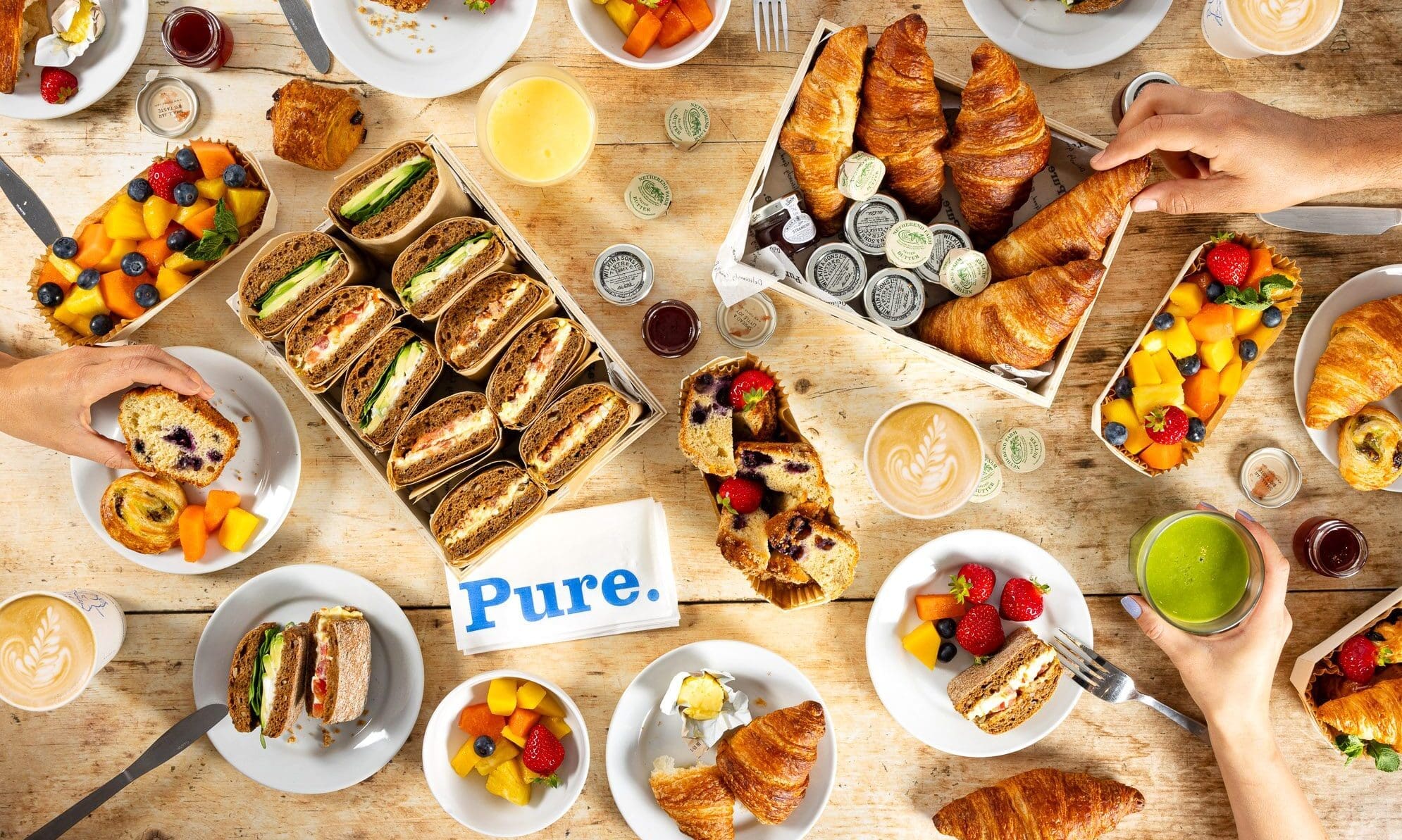
Spencer Craig, chief executive of food-to-go chain Pure, says the brand is seeing this shift first-hand. Its catering business grew by 25% year-on-year, significantly outpacing wider sector growth. He attributes that performance to a combination of brand recognition, product quality, and consistency.
“People love the food, they recognise and trust the brand, and they value the consistency of both product and service. Brand recognition is a big factor,” Craig elaborates. “When you attend a meeting or event, you don’t want a standard, pre-packed sandwich offering — you want something you’d actually choose and pay for yourself.”
Craig also points to structural factors within the market. While larger organisations may rely on contract caterers, there is a substantial segment of businesses that are too small for those arrangements but still require frequent, high-volume orders. “Those companies are increasingly ordering from high-street brands like ours in large volumes,” he adds.
Shaikh likewise sees a similar dynamic emerging, driven in part by menu fatigue. “Over time, clients experience menu fatigue and start looking for something new to keep their customers engaged,” he explains, having noticed that corporate clients are looking for variety and novelty as food becomes a more prominent part of workplace culture.
This reinforces how branded concepts can offer a faster route to innovation, as they allow clients to refresh their offer without significant investment. One part of Eatphoria’s proposition is that it reduces the operational burden on clients. “We can integrate into existing kitchen setups and take care of everything from digital and marketing assets to supply chain,” Shaikh adds.
Success in the catering space for operators such as Eatphoria and Pure hinges on high-quality food, consistent executive, and a trusted brand. It’s not terribly different from what they already have to do to maintain footfall in physical locations, which is the primary way they find their catering clientele. Craig says, “Clients know what they’re getting in terms of quality, and that builds trust,” and these elements underpin repeat business. This approach allows companies to scale with confidence.
Alongside this, flexibility and responsiveness are becoming critical differentiators. Shaikh highlights the importance of offering menus that span multiple dayparts, saying, “Clients want to maximise the value of their investment in kitchens, equipment, and staff.”
Health, sustainability, and dietary requirements are also playing a larger role in purchasing decisions among younger demographics. “Younger demographics, particularly Gen Z, are driving demand for healthier options, customisation, and variety,” Shaikh adds.
“People love the food, they recognise and trust the brand, and they value the consistency of both product and service. Brand recognition is a big factor.” Spencer Craig, CEO of Pure
With all that said, both operators are careful to stress that catering is not a simple extension of the core restaurant model. Delivering at scale requires a different level of operational capability, from kitchen workflows to staffing and supply chain management. Craig notes, “We made the necessary operational investments a couple of years ago to prepare for scaling this part of the business.” Pure’s systems and processes were built with scale in mind, allowing the business to handle large corporate orders alongside its core retail trade.
There are also limitations depending on the concept. Brands focused heavily on hot food, or those built around a single product, may find it more difficult to translate their offer into a catering format that meets client expectations for variety and reliability. “Catering at scale requires specific operational capabilities that not all brands have,” Craig adds. “Single-product concepts can struggle to offer the variety clients expect.”
Scaling up: why catering is not a simple add-on
The evolution of the market is also being shaped by platforms and logistics providers, which are beginning to invest more heavily in corporate catering. Deliveroo, for example, has launched a pilot catering service through its Deliveroo for Work division, allowing businesses to schedule group orders in advance. The move follows a 60% increase in corporate orders between 2022 and 2025, as well as continued growth in group ordering more broadly.
By partnering with courier services to handle large-scale deliveries and working with restaurant brands to create tailored menus, platforms are helping to build the infrastructure needed to support this growing segment. At the same time, their involvement highlights an underlying tension. While platforms can offer convenience and scale, many businesses still express a strong preference for ordering directly from restaurants, suggesting that operators who invest in their own digital channels may be able to capture greater value over time.
“Catering represents a significant revenue opportunity for restaurants, but only for those willing to meet customer expectations head-on.” – Christophe Delacroix, CEO of Storekit
For many in the sector, the most resilient approach is likely to be a hybrid one. Combining retail and catering allows operators to maximise the use of their assets, spreading fixed costs across multiple revenue streams while building a more diversified business.
This is already evident at Pure. “We’re now a multi-channel business, and around 30% of our sales come through catering,” says Craig. Shaikh similarly argues that the hybrid model is not only efficient but increasingly necessary at Eatphoria because “it allows businesses to maximise the use of their assets, including kitchen space, labour, and fixed costs, across different revenue streams.”
Looking ahead, both expect demand for corporate catering to continue rising over the next 12 to 24 months. As hybrid working becomes the norm, businesses will continue to look for ways to enhance the in-office experience, and hospitality leaders see food as central to that effort.
“Corporate food provision is becoming a more important part of workplace strategy, and this trend is likely to strengthen,” Shaikh concludes, while at the same time, noting that expectations around quality, convenience, and flexibility are likely to increase further.
For restaurant groups, large catering orders offer a route to incremental revenue, stronger customer relationships, and better utilisation of existing infrastructure. But it is not an automatic win. Success will depend on the ability to deliver consistently at scale, invest in the right systems, and meet a set of expectations that are evolving as quickly as the market itself.